Sutter Health’s latest national recognition reflects progress connecting hospital, outpatient and post-acute care through a stronger digital foundation.
Technology is most valuable when it helps people receive seamless care, wherever that care happens.
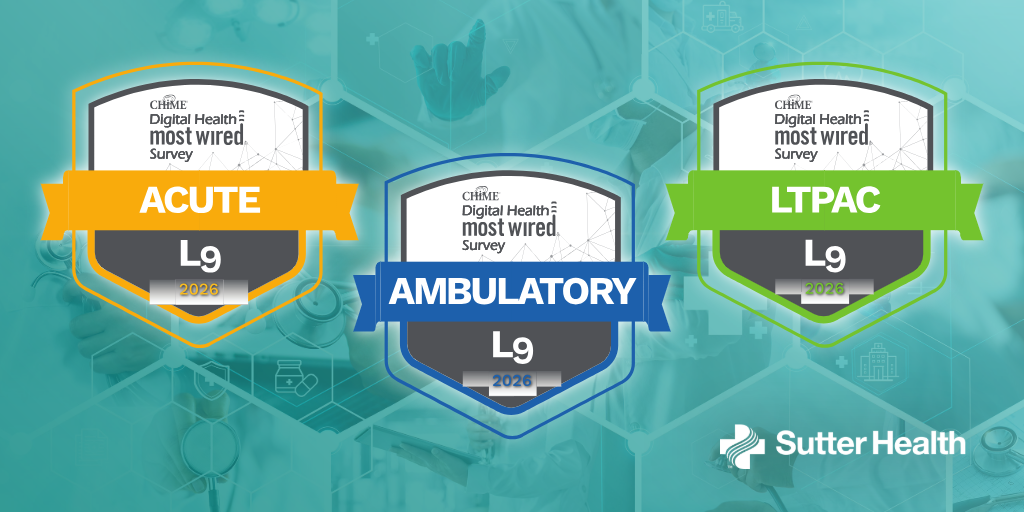
That commitment earned Sutter Health continued recognition through the Digital Health Most Wired program from the College of Healthcare Information Management Executives (CHIME). For 2026, Sutter achieved Level 9 designations across all three categories: acute, ambulatory, and long-term and post-acute care.
Both acute and LTPAC advanced from Level 8 in 2025, while ambulatory maintained its Level 9 distinction for the second year in a row.
The progression reflects an approach that goes beyond introducing individual tools. Sutter is building an integrated care ecosystem through shared platforms, stronger data systems, responsible governance and digital experiences designed to support patients and care teams across hospitals, clinics, virtual visits and care at home.
“We’re developing workflows, safeguards and digital capabilities that help technology work consistently for patients and care teams, no matter where they are,” said Laura Wilt, executive vice president and chief digital officer at Sutter Health. “That foundation allows us to continue expanding access, improving experiences and creating a more seamless healthcare system for the future.”
The annual Digital Health Most Wired program assesses both the underlying technology capabilities of a health system and how digital tools are applied to improve care — underscoring the importance of pairing a strong foundation with innovation that patients and care teams can experience.
In 2026, that foundation supported several areas of growth at Sutter.
Helping Patients Navigate Care from Anywhere
Nearly 1.4 million patients use Sutter’s digital patient portal, My Health Online, each month to manage appointments, prescriptions, test results and care team messages — helping make Sutter a national leader in online primary care scheduling.
Sutter also expanded 24/7 on-demand video visits to 365 days per year for urgent care. In its first year, the program served more than 50,000 patients, connected 17,000 to the right next step in care and “roomed” approximately 85% of patients in less than 30 minutes.
In May 2026, Sutter launched Emmie systemwide, extending personalized digital support to patients directly through My Health Online. By combining artificial intelligence with information from a patient’s EHR, Emmie helps simplify common tasks, improve access to health information and create a digital experience with less friction.
- As of September 2026, nearly 158,000 patients had used Emmie to navigate My Health Online, better understand test results and after-visit summaries and receive answers to general health questions.
- In October 2026, Sutter launched Emmie for Billing, expanding digital self-service options and helping patients better understand and manage their healthcare bills.
Extending Care Beyond the Visit
Sutter Sync connects patients managing chronic conditions with their care teams between traditional appointments. Patients can use connected devices to share readings such as blood pressure or glucose through the EHR, allowing care teams to review the information and respond to concerning trends more quickly. Since launching in March 2025, the model has expanded beyond hypertension to support cholesterol management, Type 2 diabetes and heart failure.
- As of September 2026, more than 14,000 patients were enrolled in Sutter Sync.
- Among participating patients with stage II hypertension, 90% achieved blood pressure control within six months.
“Connected care means patients don’t have to wait for the next scheduled visit to receive support,” said Dr. Richard Milani, Sutter’s chief clinical innovation officer. “When information can move securely between a patient and their care team, clinicians can identify changes earlier and patients can receive timely guidance when it matters most.”
Giving Care Teams Time Back
Digital progress is also reshaping daily work for clinicians and employees while improving the care experience for patients across settings. Together, these efforts are making care more accessible, helping clinicians make informed decisions sooner and reducing administrative burden so teams can devote more time on direct care.
- Sutter’s centralized capacity management center brings together clinical and operational teams, standardized workflows and real-time dashboards integrated with Epic to flow across the system and help match patients with available beds and the appropriate levels of care. An initial three-hospital pilot reduced excess days above the expected length of stay by 27%, the equivalent of adding 12 hospital beds each day. It also increased transfers and direct admissions by 29% and improved emergency department arrival-to-departure times by 8%, even as patient volume increased by 5%. In February 2026, Sutter expanded the centralized model to eight additional hospitals, with plans for more locations in the future.
- Using advanced analytics and AI in clinical settings to support clinician decision-making and timely patient care. Through its collaboration with Aidoc, Sutter is integrating clinical AI into existing radiology and stroke care workflows to help clinicians identify and prioritize potential critical findings for review. The technology supports earlier attention to potentially urgent findings while keeping clinical judgment and care decisions with clinicians. As of August 2026, 10 Aidoc solutions were live across the system, analyzing more than 583,000 studies and flagging more than 43,000 patient cases for clinician review.
- Ambient AI helps reduce documentation burden by drafting clinical notes during patient visits for clinician review and approval, supporting more face-to-face interaction. As of June 2026, more than 6,000 Sutter clinicians had used Abridge to draft more than five million clinical notes, with documentation time decreasing by as much as 30%. At Sutter Care at Home, average Start of Care visit documentation time has decreased from 97 minutes to 55 minutes, helping return an estimated 3,000 hours each month to Home Health care teams for patient care and other essential work.
- Streamlining nursing documentation is designed to reduce administrative burden on nurses and support more time for direct patient care. Developed with frontline nurse input to simplify routine documentation in the EHR, Nursing FOCUS has eliminated approximately 400,000 clicks per day and is projected to reduce nurse documentation burden by about 80,000 hours annually across the system.
Many of these efforts are designed to work across the health system, creating more consistent experiences for patients and enabling teams to coordinate care more effectively regardless of where care is delivered.
“A digital transformation should be felt in the moments that matter,” said Wilt. “It should make it easier for a patient to find care and get answers, help a nurse spend more time at the bedside and give a clinician clearer information without adding more work. This recognition reflects Sutter’s progress toward those outcomes.”
About the Award
With more than 44,000 facilities represented this year, the Digital Health Most Wired Survey serves as a comprehensive evaluation and digital maturity report card for healthcare organizations around the world. The achievement extends beyond information technology to every area of the enterprise, reflecting a collective commitment to advancing health and care through strategic digital initiatives.
For more information, visit www.dhanalytics.org/digital-health-most-wired-survey.