Just months after a routine mammogram came back clear, Vicky Pan felt something that didn’t belong.
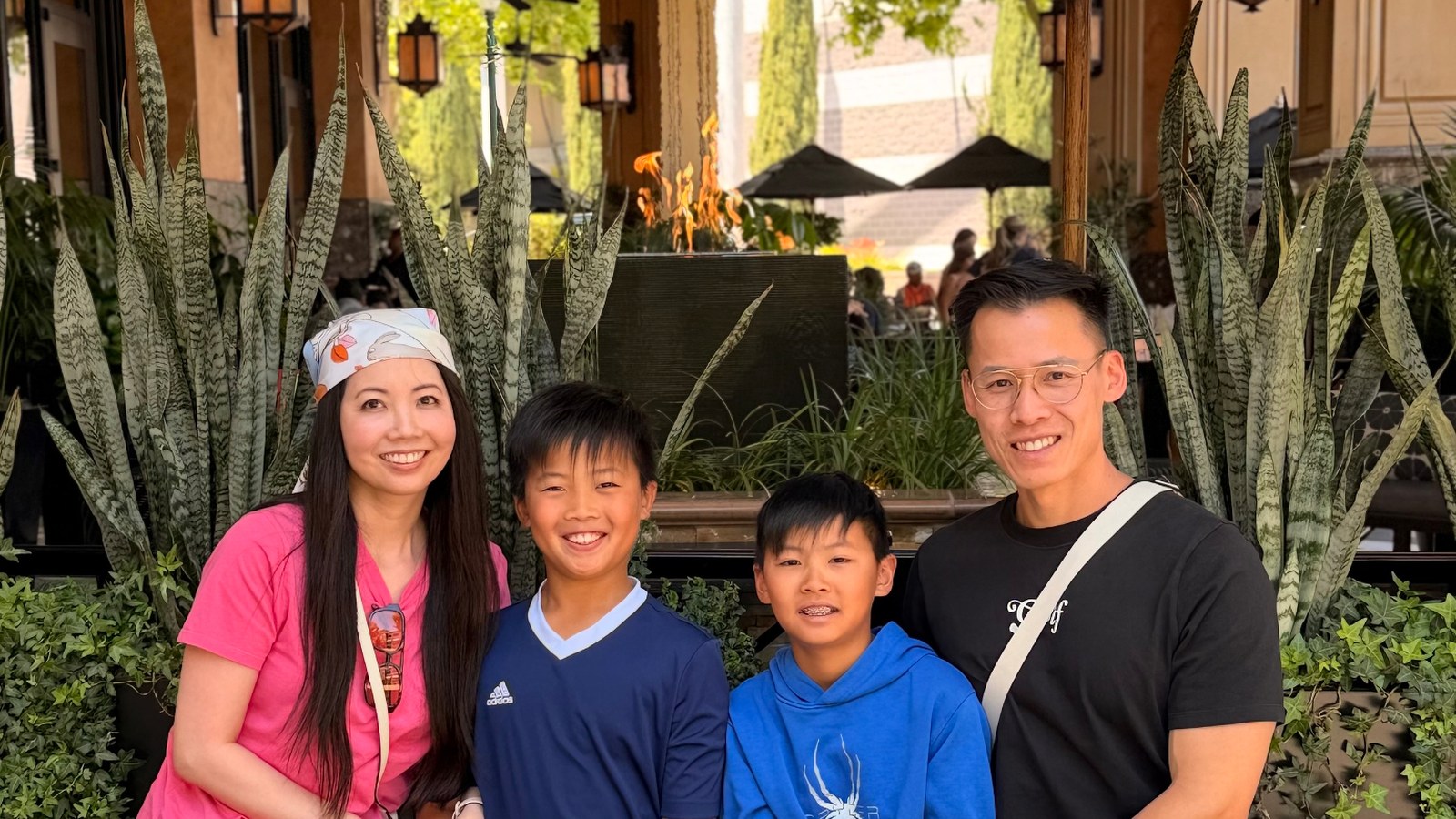
It was July 2025, and the Moraga resident was enjoying a busy summer with her husband and two young sons. She was healthy and active, and current on preventive care.
Then she found a lump in her breast.
What followed happened with dizzying speed: a doctor’s visit, ultrasound, biopsy and a diagnosis of triple-negative breast cancer, an aggressive form of the disease. Tests showed it had spread to her lymph nodes. Within a week, the 45-year-old started chemotherapy.
“It was bad news after bad news,” Pan said. “I thought I was going to die.”
Less than a year later, Pan became the first known patient in the U.S. outside a clinical trial to undergo a single-port robotic nipple-sparing mastectomy at a community-based medical center.
Dr. Rita Kwan-Feinberg, a Sutter East Bay Medical Group breast cancer and robotic surgeon with specialized training, performed the procedure at Sutter Alta Bates Summit Medical Center in Oakland.
For Pan, the surgery offered something particularly meaningful after months of cancer treatment: a way to move forward while preserving part of the person she had always known.
When she awoke after surgery, one thought brought comfort.
“I’m still me,” Pan said.
From Clinical Knowledge to Personal Reality
Pan works as a medical information pharmacist for a pharmaceutical company. Her clinical background helped her understand what was happening, but it didn’t make the diagnosis less frightening.
Her thoughts quickly shifted from clinical facts to deeply personal questions: Could her body withstand treatment? What would happen to her 9- and 11-year-old sons?
Eventually, Pan’s instinct to plan took over.
“I’m rational. I like to plan. I like to see what’s coming,” she said.
Chemotherapy took a toll. Pan lost her hair and dealt with joint pain, nausea and fatigue. Throughout it all, she found support in her care team, whom she described as “amazing.” As chemotherapy came to an end, she faced another major decision: what surgery would come next.
A New Surgical Option
She met with Dr. Kwan-Feinberg to discuss a double mastectomy. Dr. Kwan-Feinberg presented a groundbreaking option in addition to a traditional mastectomy: a single-port robotic nipple-sparing mastectomy. The approach uses a small incision near the armpit while preserving the nipple and breast skin for reconstruction. For patients who meet the criteria for the procedure, potential benefits include less visible scarring and pain, faster healing and the possibility of preserving more sensation.
A philanthropic gift from Peter Read, whose wife, Carol Ann Read, died of breast cancer, brought the robotic technology to Alta Bates Summit, where it was named “Carol” in her memory.
Pan was intrigued. She researched the technique and was impressed by Dr. Kwan-Feinberg’s training. Still, being among the first patients to undergo the procedure outside a U.S. clinical trial required trust.
“I was all for it,” Pan said. “I trust her with my life.”
Pan underwent the robotic-assisted double mastectomy in March 2026.
“This procedure is about much more than just technology and restoring physical appearance,” Dr. Kwan-Feinberg said. “It reflects a commitment to care that addresses both medical needs and emotional well-being.”
Pan’s recovery surprised her. Her pain was manageable, and three weeks after surgery, Pan traveled to Monterey with her family.
After surgery, Pan received more good news: pathology showed her lymph nodes were clear, meaning she would not need radiation therapy. Additional treatment and breast reconstruction remained ahead.
More Than a Surgical Innovation
For Pan, the procedure’s significance went beyond technology. Breast cancer and its treatment had affected not only her body but how she saw herself.
“Being able to do this through a small hidden scar means that women physically and emotionally can return back to what matters, which is living life to the fullest and not being constantly reminded of the journey they had to go through,” Dr. Kwan-Feinberg said.
That whole-person focus reflects how Sutter’s Women’s Health and Advanced Cancer service lines are working together to combine innovative treatments with personalized care from diagnosis through survivorship.
Sutter is also expanding access to advanced cancer care in the East Bay. In November, the Stanford Medicine Sutter Health Cancer Center is set to open on the Sutter Alta Bates Summit Medical Center campus in Oakland, offering access to advanced treatments, clinical trials, early detection and survivorship programs.
Finding Gratitude in What Comes Next
Before her diagnosis, Pan described herself as being at “peak happiness.” Breast cancer interrupted that life, but she doesn’t want it to define what comes next. Instead, the experience has deepened her appreciation for family and everyday moments.
“I practice gratitude,” Pan said. “It’s about being happy where you are. I am grateful I am alive.”
She knows uncertainty remains. But she also knows how she wants to approach the future.
“This has been a blip in my life,” Pan said. “I will continue on with my life. I do know others are not as lucky. I’m happy with what I have now. I live in the present.”