
By Dr. Leila Haghighat, Vitals contributor
Prostate cancer is the second most commonly diagnosed cancer in American men. Yet for decades, men diagnosed with localized prostate cancer have faced a difficult choice. They could monitor the cancer closely or treat the entire prostate aggressively with surgery or radiation.
Now, a growing class of treatments known as focal therapies is offering some patients a middle ground by targeting cancer while leaving much of the prostate and surrounding tissue intact.
“It really changes the paradigm for treatment,” said Dr. Surat Phonsombat, a urologist with the Palo Alto Foundation Medical Group (PAFMG) in Mountain View.
Dr. Phonsombat compares the shift to the evolution of breast cancer treatment. “In the older days, it used to be you get a mastectomy or you get nothing,” he said. “Nowadays, most women end up getting lumpectomies.”
There is no surgical equivalent of a lumpectomy for prostate cancer. Because of the prostate anatomy, surgeons generally cannot simply remove the cancerous portion of the gland. Focal therapy offers another approach, identifying where the cancer is located and destroying that tissue while preserving as much of the prostate as possible.
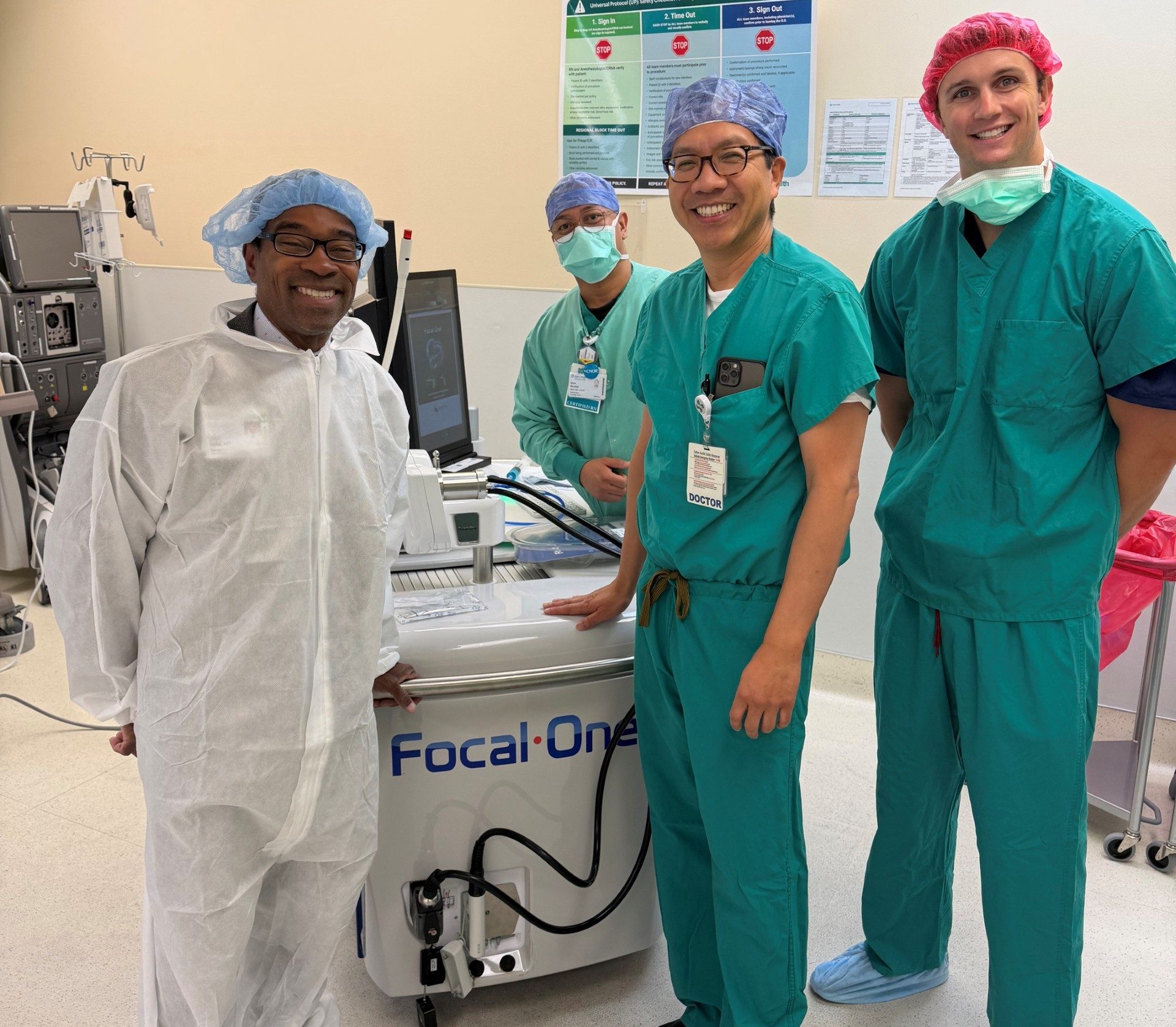
PAFMG urologists are now offering the latest forms of focal therapy, including high-intensity focused ultrasound (HIFU) and irreversible electroporation (IRE).
Targeting cancer with ultrasound
HIFU uses concentrated ultrasound energy to heat and destroy targeted prostate tissue. Dr. Phonsombat compares it to using a magnifying glass to focus sunlight on a single point.
The outpatient procedure, which he performs at Sutter Mills Peninsula Medical Center, Burlingame Campus under general anesthesia without an incision or radiation. MRI images obtained before the procedure correlated with real-time ultrasound, allowing the urologist to map the cancer and a margin of surrounding tissue. A robotic system then helps deliver focused ultrasound energy across the treatment zone.
By limiting treatment to part of the prostate, HIFU can minimize damage to surrounding tissue and reduce the risk of urinary incontinence and erectile dysfunction, two major quality-of-life concerns for men undergoing prostate cancer treatment.
Patients typically return home on the same day with a urinary catheter that is typically removed within the week.
Another approach using electrical energy
Dr. Tin Ngo, a PAFMG urologist practicing in Mountain View and Los Gatos, offers another focal therapy called IRE.
During IRE, four or five thin needles are inserted through the perineum–the area between the scrotum and the anus. The needles reach the prostate under ultrasound guidance and are positioned around the area to be treated. Electrical current passes between the needles, destroying tissue within the targeted zone.
Dr. Ngo was drawn to the technology because of the control the needle placement gives him.
“I felt like I had better control over where I could focus the energy to treat the tumor,” Dr. Ngo said.
IRE requires anesthesia and is somewhat more invasive than HIFU because it involves needle placement, but it remains an outpatient procedure. Patients generally have a urinary catheter for about a week and, in Dr. Ngo’s experience, recover quickly after it is removed. He has seen very few cases of incontinence or erectile dysfunction among his patients. Because IRE does not generate heat, healthy tissue remains free from potential damage.
There is currently no strong evidence that one focal approach is superior to another, Dr. Ngo said. Instead, treatment can be tailored to the patient and the characteristics and location of the cancer.
Filling a longstanding treatment gap
For urologists, focal therapy helps fill a gap between active surveillance and whole-gland treatment.
Some prostate cancers grow slowly enough to be safely monitored, while others clearly require definitive treatment with surgery or radiation. But some patients fall between those groups.
“There wasn’t an in-between option where you could try to treat the cancer, but maybe not as aggressively,” Dr. Ngo said. Another potential advantage of focal therapy is that it preserves future treatment options. If cancer later appears elsewhere in the prostate, another focal treatment may be possible, or patients can still undergo surgery or radiation.
Dr. Phonsombat likens the strategy to the carnival game Whac-A-Mole.
“Prostate cancer tends to be multifocal,” he said. “It’ll come up in one spot, we can hit it with HIFU, and then if it comes back again, you can always go back and treat it with another session at another location.”
Focal therapy is not appropriate for everyone. The best candidates generally have localized, low- to intermediate-risk disease in which MRI findings correlate closely with biopsy results. Significant cancer involving both sides of the prostate can make focal therapy less appropriate.
Ultimately, HIFU and IRE are part of a broader range of prostate cancer treatments available through PAFMG, including active surveillance, robotic surgery, brachytherapy and external-beam radiation. Sutter Mills Peninsula Medical Center, Burlingame Campus was recently recognized by the Surgical Review Corporation as a Center of Excellence in Prostate Treatment, reflecting its dedication to specialized prostate cancer care. Rather than favoring any single approach, the goal is to match treatment to the individual patient and his cancer.
“Prostate cancer comes in a lot of different varieties. It’s like going to Baskin-Robbins. You have lots of choices to make,” Dr. Phonsombat said. Age, overall health, the volume of cancer, and the characteristics of the disease all factor into those decisions.
“It’s not one-plan-fits-all,” he said. “Every time we have a new prostate cancer patient, we provide individualized care to that patient.”