Healthcare has moved beyond asking whether artificial intelligence will transform care. The more urgent questions are where it can make a difference, how organizations should measure its values and what responsible use requires.
As transformative as AI is, questions still linger about its impact. Or more precisely, how to evaluate it. AI has broken the mold in many ways – including within healthcare – and that may mean rethinking the measuring stick, too.

Sign to Sutter’s Innovation Center on Pier 1 in San Francisco with skyline behind
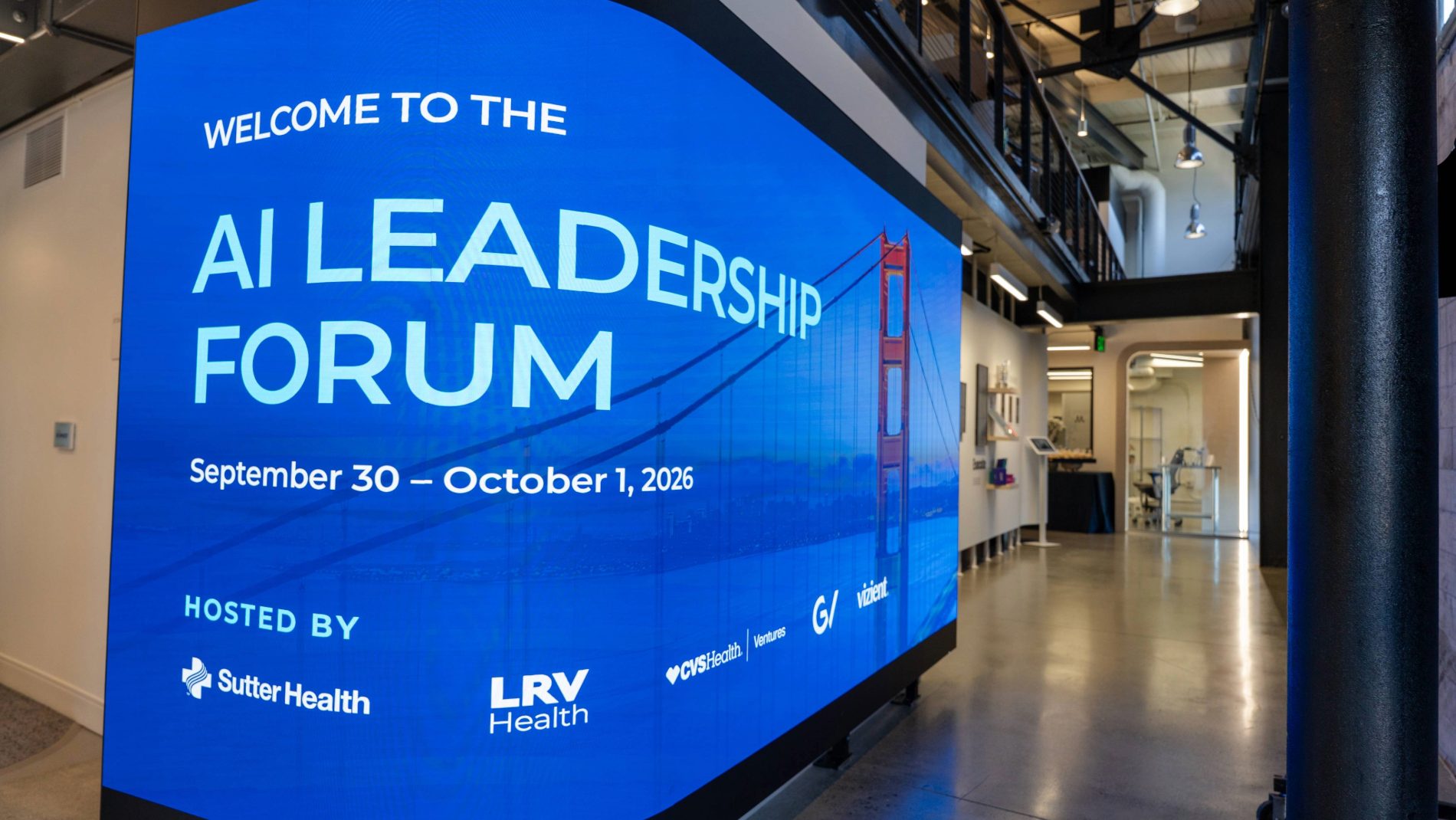
Sutter Health recently welcomed healthcare and technology leaders for the AI Leadership Forum at its Innovation Center in San Francisco. Co-hosted with LRVHealth, CVS Health Ventures, Google Ventures and Vizient, the two-day forum focused on lessons from early AI adoption and how organizations can make informed decisions as the technology advances.
“Healthcare leaders are working through many of the same questions about where AI can make the greatest difference,” said Laura Wilt, executive vice president and chief digital officer at Sutter Health. “Candid conversations about what is working, what is not and what we are learning can challenge our thinking and help us make better decisions for patients and the people who care for them.”
From Promise to Practice
The forum opened with a conversation moderated by Wilt about what may become possible over the next few years as AI takes on a greater role within clinical workflows. Other sessions examined where AI is proving useful and where questions remain.
Dr. Ashley Beecy, Sutter’s chief AI officer, joined leaders from OpenAI and Epic for a discussion moderated by Dr. Richard Milani, Sutter’s chief clinical
innovation officer.
Leaders examined several questions shaping healthcare’s next phase of AI use:
- How should organizations define value when financial returns tell only part of the story?
- What does responsible use require as AI moves closer to patient care?
- How can organizations choose and introduce tools that support clinicians without
adding complexity?
- Can AI help make healthcare easier for patients to navigate?
Examples included ambient documentation and chart summaries that can reduce time spent on charting, while automated outreach can help patients receive timely follow-up care. Participants also discussed emerging tools that make specialized knowledge more accessible across a team.
The discussions also reinforced that a successful pilot is only the beginning. Sutter saw this firsthand when an AI tool performed well in one area but proved difficult to apply reliably across different workflows. The team paused and adjusted its evaluation process to assess workflow readiness earlier. The experience reflects a broader lesson: Successful adoption requires early planning, involvement from the people closest to the work and a culture shaped by clear leadership, transparency and shared purpose.
“Responsible use starts with being honest about the problem we are trying to solve,” said Dr. Beecy. “Will a tool improve care or make care easier to deliver? If we cannot answer that clearly, we should question whether AI is the right tool at all.”
Navigating Responsible Use
Discussions also addressed trust, privacy, security, accountability and human oversight, as well as how new tools may affect roles and workflows.

Whiteboard illustration of AI’s positive impact in healthcare on patient care
AI may help organize information, identify patterns or reduce repetitive tasks, but clinical judgment remains with the clinician. The expertise, listening and personal connection clinicians and care teams bring to each patient interaction remain essential.
“AI should support clinical judgment, not replace it,” said Dr. Beecy. “That means evaluating tools in real clinical settings, involving the people who will use them and continuing to assess whether they are helping us deliver better care.”
Participants noted that AI’s value extends beyond financial return to the time and capacity it creates, and whether those benefits improve care or make it easier to deliver. The patient experience provides another measure, including whether AI can help people move from receiving information to taking the next step in their care.
Other conversations examined whether organizations should build capabilities internally, purchase established tools or work with outside partners. The choice is rarely all or nothing. Whatever the approach, leaders emphasized starting with a clear problem, planning for adoption and understanding how a new capability will fit into daily work.
Learning From Healthcare and Beyond
Answering healthcare’s questions about AI will require a range of perspectives. The forum brought together health systems, payers, technology companies, researchers, investors and entrepreneurs to compare experiences.

Sutter’s Chris Waugh and Rahul Joglekar presenting on innovation at Sutter
“Some of healthcare’s most difficult challenges benefit from perspectives both within healthcare and beyond it,” said Chris Waugh, Sutter’s chief innovation officer. “Different experiences can help us see problems in new ways and turn promising ideas into approaches that work for patients and care teams.”
These exchanges also help build a broader community around shared learning.
“The forum was designed to create connections that continue well beyond the event,” said Rahul Joglekar, Sutter’s head of venture and strategic partnerships. “Having a community of peers to learn from will be increasingly valuable as healthcare works through the practical challenges of implementing AI and applying it more broadly.”
Delivering on AI’s promise starts with solving real healthcare challenges in ways that improve care, make it easier to navigate and support the people delivering and receiving it.