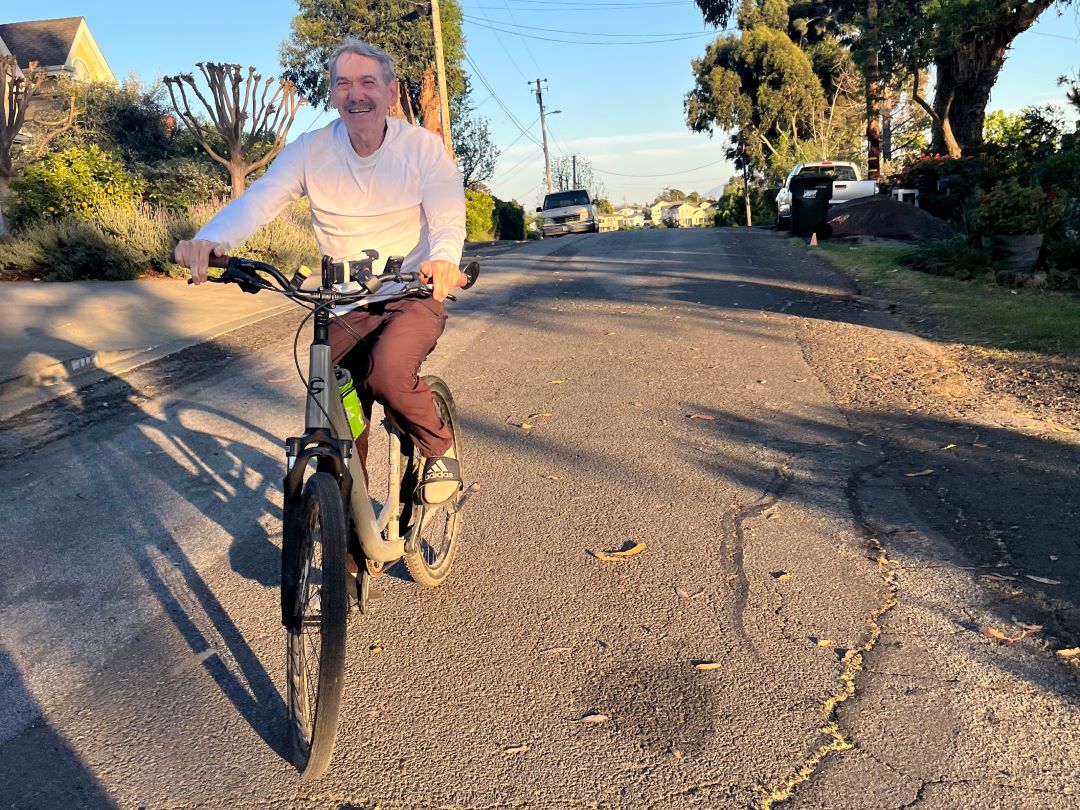
How advancement in minimally invasive treatment is helping patients get back to life.
By Dr. Leila Haghighat, Vitals contributor
On most days, Les Kalman prefers not to sit still for long.
A psychiatrist by training, he once converted his van into a mobile office to care for patients across rural stretches of the Bay Area. Movement, for him, has always been a way of life — something closer to instinct than routine. Even later in life, he would spend hours at the gym, pushing himself on the ergometer and StairMaster.
“I’m like a shark,” he said. “I have to keep moving.”
So when his regular bike rides along the marsh-lined trails near his home in Benicia began to slow — when breathing came harder and distances felt longer — he worried.
Years earlier, at age 68, Kalman experienced the same quiet changes: shortness of breath and a subtle but steady loss of stamina. He was diagnosed with a leaking mitral valve and underwent open-heart surgery to repair it. The operation was successful, but recovery took nearly six months.
Now the pattern was repeating.
Evaluations at two leading academic centers confirmed his suspicion, his mitral valve was leaking again, and he would need another open-heart surgery.
“I was pretty apprehensive,” Kalman recalled.
A Different Path Forward
Looking for alternatives, Kalman connected with Dr. Elliott Groves, a cardiologist with the Palo Alto Foundation Medical Group (PAFMG). What he heard next changed everything.
Instead of another major operation, Dr. Groves recommended a minimally invasive procedure called transcatheter edge-to-edge repair. Rather than opening the chest, a clip would be inserted through a small incision in the groin and guided to the valve to help it close more effectively and reduce leakage.
For Kalman, the choice was clear. Shortly after his initial consultation, he underwent the procedure.
“It was a great experience,” he said. “It didn’t knock me down for months like the surgery did.”
After completing cardiac rehabilitation, Kalman quickly returned to his active lifestyle —cycling and even playing football with friends. He also avoided some of the challenges he experienced after his prior surgery, including prolonged blood thinners.
“Above all, I felt safe through the process,” he said. “And that’s a powerful feeling. I am forever grateful to Dr. Groves for giving me my life back.”
A Growing Field, Changing Lives
Transcatheter mitral valve repair is one example of the rapid evolution of structural cardiology, a field focusing on treating heart conditions without traditional open-heart surgery.
In the past, large incisions and long recoveries were the norm. Now, advances in technology allow many patients to be treated using minimally invasive approaches, often with shorter hospital stays and faster return to daily life.
“There’s a common misconception that once you’ve had heart surgery, repeat surgery is the only option,” Dr. Groves said. “That’s no longer the case.”
Expert Care Close to Home
The PAFMG structural cardiology program has become a regional leader in these advanced therapies.
Since 2023, over 2,500 structural heart procedures have been performed, mostly at Sutter’s Mills-Peninsula Medical Center in Burlingame. Volumes continue to rise, increasing by more than 35% in just two years.
Across the Bay Area, multiple PAFMG providers offer structural heart interventions, including Dr. Groves and colleagues Drs. Chad Rammohan, Tim Hinohara, Amin Manuchehery, Neil Sawhney, and Tom Oka.
The PAFMG structural program has also earned national recognition. The transcatheter aortic valve replacement, or TAVR, program in Mountain View recently earned a prestigious 3-star rating for exceptional safety and outcomes. This distinguished PAFMG as one of fewer than 5% of programs nationwide to receive this accolade, alongside Sutter Sacramento.
More Than Valves, Expanding Possibilities
While many structural heart procedures focus on repairing or replacing valves, others address a broader range of conditions.
Some patients with atrial fibrillation may be able to stop their long-term blood thinners after implantation of a small device—known as a Watchman or Amulet—that seals off the area of the heart where clots commonly form. Other procedures can close defects present at birth, such as a patent foramen ovale or atrial septal defect.
Each treatment is carefully tailored to the individual, based on anatomy, overall health and long-term goals.
A Team Approach to Heart Care
Behind every successful structural heart procedure is a coordinated, multidisciplinary team.
Patients are typically referred by their general cardiologist and evaluated jointly by an interventional cardiologist and a heart surgeon. During procedures, an imaging specialist provides real-time guidance using advanced cardiac imaging.
“The success of our program is really a reflection of teamwork,” Dr. Groves said.
Looking Ahead
As new technologies continue to emerge, the possibilities in structural cardiology are rapidly expanding, offering patients access to effective, less invasive care.
“This is one of the most exciting areas in cardiology today,” Dr. Groves said. “We want more patients — and their doctors — to know what’s possible.”
For patients like Kalman, the impact has been life changing. These days, his biggest challenge isn’t limitation but knowing how far he can push himself.
And that, he said, is a problem he’s happy to have.