
New research aims to reconnect patients with abdominal aortic aneurysms before a silent condition becomes life-threatening.
By Jenn Lonzer, Vitals contributor
When 64-year-old Rogelio Hortizuela began preparing for a kidney transplant, imaging revealed an abdominal aortic aneurysm (AAA) that had grown large enough to require treatment.
It wasn’t the first time it had been seen.
Doctors later discovered the aneurysm had been noted on imaging in 2020 but had never been acted upon through ongoing surveillance. Without regular follow-up, it continued to grow unnoticed.
A Silent Killer
Hortizuela never had symptoms.
Like many AAAs, it was completely silent.
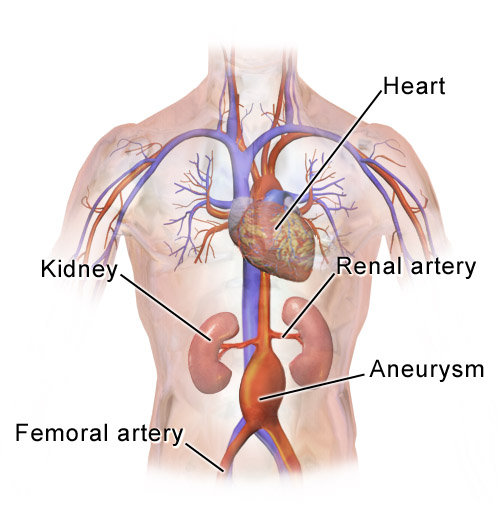
Image courtesy of: BruceBlaus, CC BY-SA 4.0, via Wikimedia Commons
“It was shocking to find out I needed surgery,” says Hortizuela. “We thought the tests were just routine… I’d been on peritoneal dialysis for a while and have been on the kidney transplant list for a couple of years now. The news of this aneurysm was overwhelming. It felt like one thing on top of another.”
An AAA is an enlargement of the aorta, which is the body’s central circulatory highway. AAA is often called a silent killer because it can expand without causing any physical warning signs. As it grows, the risk of rupture increases – a medical emergency that is often fatal. Yet many people don’t know they have an aneurysm until it’s found during imaging performed for another reason.
For patients with smaller aneurysms, surgery usually isn’t needed right away. Instead, physicians monitor the aneurysm with regular imaging to watch for changes. If it grows beyond a certain size or begins growing rapidly, doctors can intervene before it becomes life-threatening.
For Hortizuela, that opportunity almost slipped away.
Fortunately, Hortizuela’s transplant team recognized the urgency of his condition and referred him for prompt evaluation by Dr. Hernan Bazan, chief of vascular and endovascular surgery for Sutter West Bay Medical Group and medical director of vascular surgery at Sutter’s CPMC. After careful evaluation, Dr. Bazan performed a minimally invasive endovascular aneurysm repair (EVAR). Unlike traditional open surgery, which requires a large abdominal incision and an extended hospital stay, EVAR is an advanced technique where a small, fabric-covered device called a stent-graft is threaded through tiny groin punctures to reline the weakened artery from the inside. This is one of the several minimally invasive ways that aortic surgery is being done to avoid complications during surgery.
“Remarkably, despite Hortizuela’s complex health profile – including long-term peritoneal dialysis and active standing on the kidney transplant list – this precise approach allowed him to be safely discharged home the day after surgery, dramatically fast-tracking his recovery. Hortizuela recovered well and is now continuing his journey toward kidney transplantation,” says Dr. Bazan.
What If Care Came Looking for You?

Rogelio Hortizuela
For Dr. Bazan, the case reflects a challenge he sees all too often.
“Many patients with smaller aneurysms don’t need surgery immediately,” he says. “What they do need is regular imaging so we know exactly when it’s time to intervene. If patients don’t receive the follow-up care they need — or never realize they need it — we lose that opportunity.”
Cases like this underscore the importance of the work Dr. Bazan and his team are already leading. Dr. Bazan was recently one of two Principal Investigators nationally to be awarded an aortic research grant through Medtronic’s External Research Program to operationalize this proactive screening framework over the next 18 months.
“This funded population health initiative specifically scales up our infrastructure, allowing us to deploy a specialized algorithm across Sutter Health’s electronic health record to identify patients with a known abdominal aortic aneurysm who have not received recommended follow-up care in more than 18 months,” he says.
Using a specialized algorithm, the research team will search Sutter’s system of approximately 3.6 million patient records to identify people who may have been lost to follow-up. After physicians review each case, centralized nurse navigators will reach out to patients and help reconnect them with the imaging and appointments needed to safely monitor their aneurysms.
Rather than waiting for patients to return after a complication develops, the goal is to identify them before an emergency occurs.
“This grant allows us to build an invisible safety net for our most vulnerable patients,” says Dr. Bazan. “By actively finding and re-engaging those who have slipped through the cracks, we have an opportunity to prevent emergencies before they happen while giving patients and their families greater peace of mind.”
Beyond abdominal aortic aneurysms, the project could demonstrate how health systems can use electronic health records, data analytics and nurse navigation to keep people connected to care for chronic conditions. If successful, the approach could become a model for identifying patients who are overdue for recommended care before preventable complications occur.
For Hortizuela, finding the aneurysm in time meant he could safely move forward with the next chapter of his care. He does have another small AAA and will be sure to get all the recommended screenings. Dr. Bazan hopes this research will help more patients receive that same opportunity – before a silent condition becomes a life-threatening emergency.